The Roques de García, guardians of Teide
Back to all places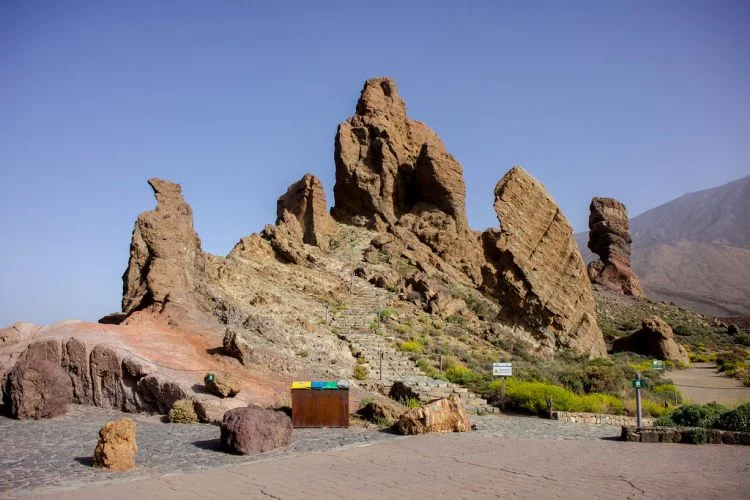
The Roques de García are exceptional rock formations in one of the most beautiful and magical landscapes on the entire island of Tenerife. They are listed as a UNESCO World Heritage Site since 2007, and with their verticality they seem to guard the true protagonist of this territory, Teide, the largest volcano in Spain and the third largest in the world. It is one of those spaces that amaze, that you have to know and that no visitor to the island can rule out. The setting where the Roques de García are located could not be more impressive. To the left, we see the Pico Viejo with 3155 meters of altitude; and to the right, the majestic Teide with its 3712 meters. These unique rock formations are caused by the erosion produced by millions of years that split in two the calderas or volcanic chimneys of the great volcanic circus of Las Cañadas del Teide.
The most famous rocks in Tenerife have accumulated over time different volcanic materials that apparently belonged to an ancient and immense volcano that predated Teide. Volcanologists are still investigating to explain the origin of these rocks, due to their strangeness and particularity. In addition, its reddish tones give the landscape a tone and a setting like a science fiction movie. And that is not to mention the curious species of endemic flora that cling to the rocks, colonizing this world of lava. It is also easy to see among the rocks some black lizard with its peculiar blue coloration.
Roque Cinchado is one of the most famous rocks in the Teide National Park. It is also popularly known as the "Finger of God" or "Stone Tree", for having a shape similar to a "tree", although without fruit or leaves. The Cinchado rock is so symbolic and particular that it was chosen to appear on the back of the old 1000 pesetas bills. Other rocks are also known, such as La Catedral or La Cascada for their spectacular shapes, and other smaller ones, such as Torrotito, El Burro or Roque Blanco.
The erosion that gave rise to the Roques de García is mainly due to wind, rain and temperature changes. In the case of Roque Cinchado, the rock formation had a somewhat different process than the rest of the rocks, because successive layers of materials have accumulated in it in a particular way. Hence its strange and beautiful balance that seems to defy the laws of physics and gravity. The height of Roque Cinchado is 27 meters and it presents a curious mixture of earth colors, ranging from reddish, ocher, copper and brown. When the top of Teide is covered in snow, its appearance is even more spectacular due to the contrast of colours.
La Cañada and Llano de Ucanca are the edges of the ancient calderas of the volcano eroded by the passage of time. Sometimes, this sedimentary plain is covered by water that slides down the walls of the volcano, forming small lakes. The area, with the Roques de García always ready to appear in the photo, will remind you of the lunar landscapes of fantasy movies and will make you feel that you are in a very particular space, like from another planet. It is enough to remember that many scenes of the movie Clash of the Titans were filmed here in year 2012, in which mythological Greece was recreated, with Perseus leading a dangerous mission in which he had to face giant scorpions.
One of the most beautiful routes in the entire Teide National Park starts from the Roulette viewpoint. It is a circular path of about 3.5 kilometres, which takes about two hours to complete and is not very difficult, leaving the Roques de García on the left. Afterwards, the path continues down until it reaches the Llano de Ucanca, the largest ravine in the national park. During this descent you pass next to La Cascada and La Catedral which, together with Roque Cinchado, are the most spectacular formations in the group of rocks. Next, the ascent will begin that will take us to the starting point.
The entire area of the La Roulette viewpoint and the surrounding spaces are conditioned by a fenced path that passes through the place where the Roques de García are located, so there is no danger of getting lost. Attention! Do not leave the marked trails.
28.22319, -16.63070