Pino Gordo
Back to all places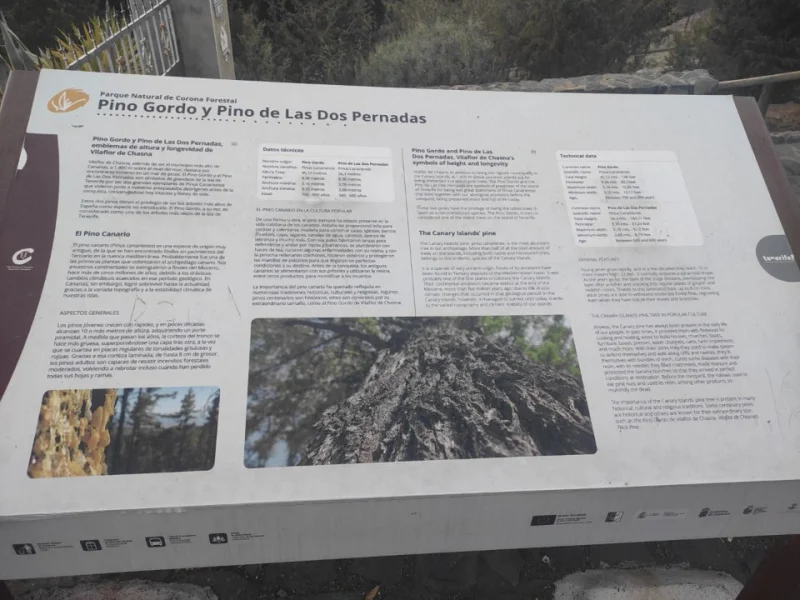
Pino Gordo is an impressive ancient tree! Just picture yourself standing beneath this massive pine, towering nearly fifty meters tall. It is exciting to think that when the seed that eventually grew into this magnificent tree started taking root, Marco Polo had not even been born yet. Back then, the land we now call Spain was mostly under the rule of the Moors and Islamic influence. Nation-states as we know them today had not even come into existence, and cities were gathering together in the Hanseatic League while the Crusades were still gaining momentum. By the time Columbus made a stop at the Canary Islands on his journey to America, Pino Gordo had already been standing tall for three hundred years. Imagine that! This pine tree has witnessed so much history. And it is still here, around 800 years old, reaching a height of about 45 meters. The circumference of its trunk measures an impressive 9.3 meters. They aptly named this tree "Pino Gordo," which means "thick pine." This name truly fits, considering the substantial girth of its trunk.
Canary pines play a vital role in providing water to the islands. They gather moisture from the clouds, which condenses on their long needles. They release nearly half of the water they collect into the soil, using up their reserves. In the forest, you can see tiny water droplets on the ends of the pine needles. Because these pines contain so much water, they are resistant to forest fires. Even if the fire burns the entire canopy and chars the bark, the following year new shoots will emerge from the trunk. In a canary pine forest that survived a fire many decades ago, only someone with experience can spot any traces of the past event.
Canary pines go through a needle replacement process every two or three years. As a result, a thick layer of dry needles, about 20-30 cm long, accumulates under the forests. Since ancient times, this layer has been a valuable resource for the Canaries, known as "pinocha." The people responsible for collecting pinocha from the mountains are called pinocheros. Pinocha has served various purposes. It was used to fill mattresses, giving them a comfortable yet springy feel. People with fewer resources even filled pillows with pinocha. Additionally, pinocha was highly valued as bedding for goats. It also had applications in construction, where bundles of thorns were used to build primitive barns, reinforced with twig frames. Moreover, pinocha was used as a humus layer in terraced fields and banana plantations, often mixed with manure to support the growth of potatoes and bananas in the acidic soil of the volcanic island.
Currently, the collection of pinocha is regulated by special permits, as per existing laws. However, with this regulation, a substantial layer of thorns is left under the forest, making the forest floor highly susceptible to fires. Therefore, caution must be exercised to prevent the occurrence of wildfires in the Canarian forests.
Photo: Priit Kivi
28.16525, -16.63689