Masca
Back to all places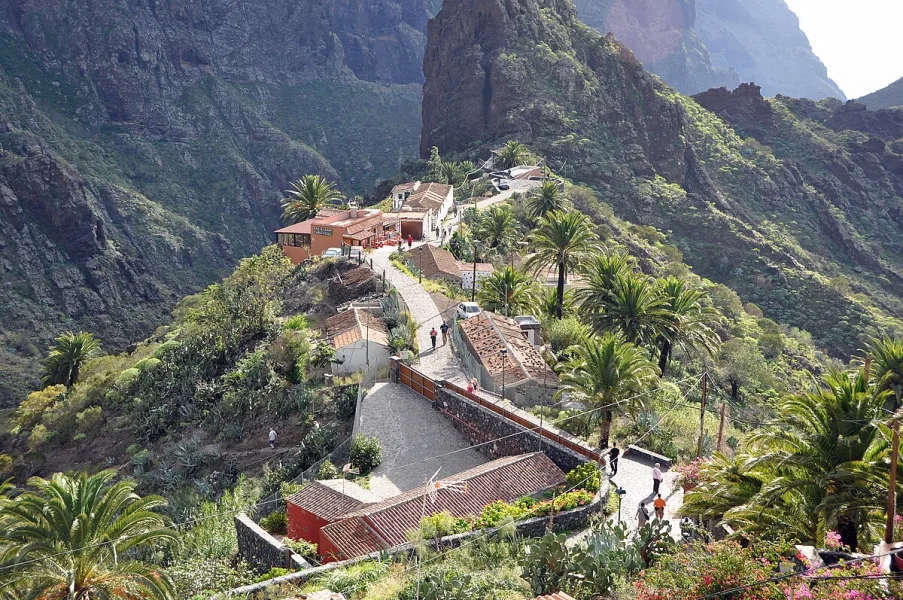
Masca village is a dream destination for every landscape photographer, Masca is magnificent at every angle. No poetic words can do justice to the beauty of this quaint little village, hidden in the folds of the Teno Mountains. The setting of the village is surreal, and its houses perch perilously on the narrow ridges of dramatic rock formations. Dubbed as the Machu Picchu of the Canaries, the village center is situated along a ridge underneath a bullet shaped pinnacle. Steep ravine walls rising on either side of the village add to its beauty. It is estimated that some 80 inhabitants currently live in Masca, mostly dedicated to managing rural houses, restaurants and craft shops. This has always been a narrow and remote place, which was only very recently supplied with electricity, and where the roads were barely more than dusty tracks up until not long ago. In fact, for years the only means of communication with the rest of the world was the donkey trail of Camino de los Guanches, linking Masca to Santiago del Teide. But that remoteness is precisely what has allowed it to keep its ancient charm. Despite its small size, the area boasts a collection of valuable treasures such as the house of Los Avinculados in the hamlet of Piedra, and a tiny 18th century church. It even has a museum and a craft centre that have been set up inside one of the houses. A rock formation that was once used as an aboriginal sanctuary not far from the hamlet revealed an archaeological site featuring cave art. Legend has it that as a remote and solitary place, this was a favourite hideout among the pirates who roamed the Island.
In reality, the tiny settlement was the last refuge of Tenerife’s original inhabitants, the Guanche, who held out against the inevitable conquest in the caves of its deep "barranco" or ravine and its steep cliff walls. For centuries a small community farmed the precipitous terraces where two gorges meet and it wasn’t until the road connecting Santiago del Teide to Buenavista was constructed in the 1970s that the rest of the world found Masca. Next to the village road you will find a statue of Don José Pérez. He was the village elder of Masca who managed to bring electricity and road connection to Masca. It was quite a tough job that required his full dedication. So nowadays it is customary to rub his nose in order to achieve the fulfillment of your seemingly impossible wishes. Another legend about Masca tells a story about Pedro. Many years ago, in Masca lived a young boy named Pedro Fourth Alvarez. He was the fourth Pedro in Alvarez family, the name of the Pedro was worn by his father, grandfather and great-grandfather. His passion was to explore the unbelievably beautiful rocks surrounding his village. One day he discovered the entrance of a cave, high above ground level. When Masca was threatened by a pirates’ attack, Pedro took all the inhabitants of the village to the cave, using a previously made rope ladder. When the pirates appeared, they were unable to climb the cliff and did not know there whereabout of the villagers. Then Pedro led the villagers in a successful attack against a pirates ship moored at the foot of the rocks, while the pirates were on the land, unsuccessfully looking for the inhabitants of Masca. Some pirates were killed and the inhabitants captured the pirates loot, making the village rich. Residents later attacked other pirates ships, until they acquired fame and a reputation of invincibility that scared the pirates away forever. Pedro was elected leader of the village and, to express their gratitude, the inhabitants placed on the rock near the entrance of the cave, a huge medallion, depicting the heroic Pedro with a dog sitting at his feet, the symbol of the Canary Islands.
28.30535, -16.83991