Drago de Icod de los Vinos
Back to all places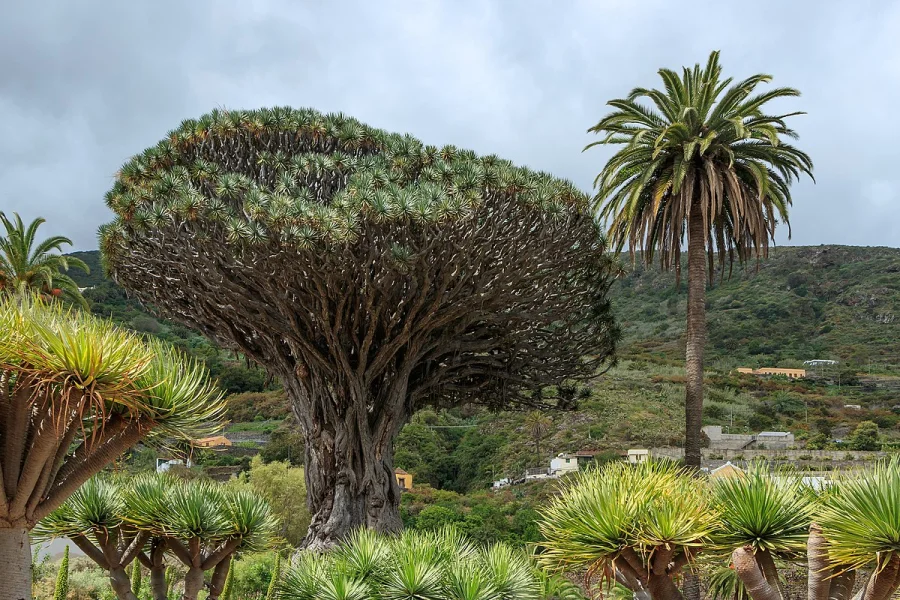
Millennial dragon tree was formerly considered to be more than 3000 years old. There are various versions about the age of the dragon tree, but since the dragon tree does not produce rings or renew its bark in a cyclical way, it is not possible to define its age precisely. What we know is that when the city was founded in 1511, the dragon tree was already big, the oldest surviving image is from seventeenth-century engraving, where it is not much smaller than it is today. So let’s accept the fact that it is a very old tree indeed that has seen native Guanches, conquistadors, and the Inquisition. Common understanding today is that the tree estimated age is about 700 years. There are two explanations for the name dragon tree - its unusual appearance and its red sap. According to a legend, dragon trees sprout from the blood spilled by flying dragons in the spot where a lizard has been killed. The dragon tree has been known in Europe since ancient times. Its sap was used to make sealing wax, paints and ointments. At some point the juice of the dragon tree was worth the price of gold, as it was considered an valuable medicine for the treatment of bleeding, wounds and dysentery. The Guanches used the sap of the dragon tree when embalming their dead.
The dragon tree is a tree-like plant belonging to the group of Monocots. It is a woody herbaceous plant, rather than strictly tree. It is about 18 meters tall and it has a perimeter at the base of the trunk of 20 meters.
The trunk has a huge cavity that rises up to 6 m high. In 1985 a deep sanitation was carried out and a fan was installed inside the trunk to facilitate air circulation and prevent the proliferation of fungi.
Now I tell you the legend about the dragon tree.
One remote afternoon in the past, a certain merchant sailor arrived from the Atlantic coasts in search of dragon’s blood, a very fashionable product and of great importance in the elaboration of rare medicin, and landed near the beach of San Marcos, of Icod de los Vinos, to carry out its lucrative purpose. Being already on the beach, he surprised there some young women of this land, who bathed alone in the sea that summer afternoon. The sailor pursued them, managing to seize one of them. She cunningly tried to win the heart of the strange traveler in order to distract him and manage to flee, and showing him signs of consideration and friendship offered him some beautiful fruits of the earth.
For that sailor who came after the blood of the dragon, and brought in his imagination and in his soul the Hellenic myth of the Hesperides, the fruits that woman of this land offered him, could very well have seemed like apples from the mythical garden. While he gladly ate unsuspectingly, the beautiful aborigine jumped agilely to the other side of the ravine, and at full speed she fled towards the nearby grove, hiding herself. The sailor, surprised at first, tried to pursue her, but was surprised to see that something was standing in his way, that a strange tree was moving its leaves like infinite daggers, and that the trunk, similar to the body of a snake, was shaking with the wind and between its tentacles the beautiful Guanche maiden was hidden. The sailor threw the dart that he was carrying in his hands, against what he thought was a monster, with great fear and astonishment, and when it remained stuck in the trunk, the end of the javelin began to drip liquid blood from the dragon. Confused and frightened, the man fled down the slopes, got into his small boat and moved away from the coast, while he was thinking in his heart, that he had surprised one of the Hesperides in the garden, which the mythical Dragon came out to defend.
28.36656, -16.72219