Basilica of Candelaria and the Black Madonna
Back to all places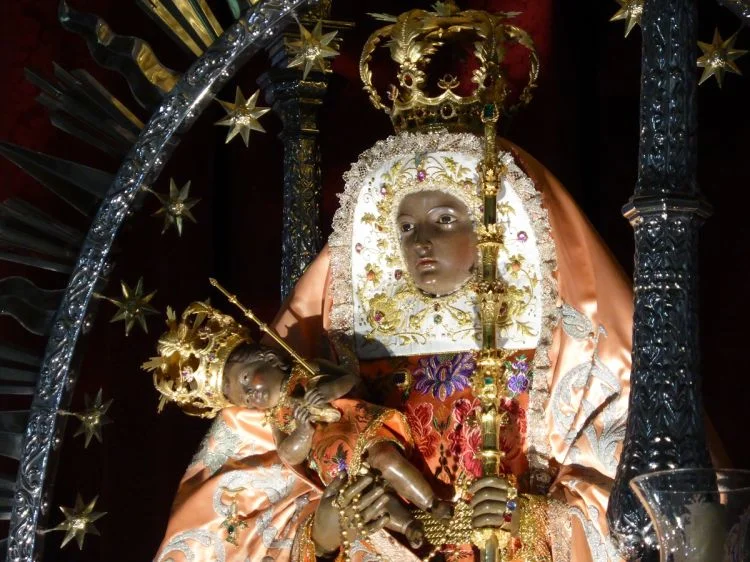
Six hundred years ago, two Guanche who were fishing on the beach of the ocean found a darkened figure of a woman holding a child in her arms. Apparently, it was a ship’s hull that broke loose after a shipwreck or a more serious accident and drifted onto the beach of Tenerife. The Guanches treated the statue with great respect and installed it in a cave by the ocean, where they then went to worship the statue. When the conquistadors came, they didn’t dare to destroy the statue, probably for the very reason that in the Middle Ages there were a lot of black or dark Madonnas in Europe. There are many theories of their origin, but it is generally believed that the black madonnas were originally the most common statues or icons of the Virgin Mary with the baby Jesus, which simply got covered with candle soot over time and thus acquired a new meaning. However, this theory is disputed by, for example, the Gnostics, who refer to the Old Testament Canticle chapters one-five I am black, but handsome, O daughters of Jerusalem. Be that as it may, the black madonna was beautiful in a cave by the sea until the year eighteen hundred and twenty-six, when a storm again swept her into the water and took her away. The Canaries, as a nation that generally relies on predestination and the guidance of higher forces in everything, of course considered this an exceptionally bad omen, and within a year a new Madonna carved by the master Fernando Estevez was ready, which, in contrast to the former modest sculpture, is richly decorated with gold and stone and resembles analogs common in Europe. The rock church built around the Madonna in the sixteenth century was replaced by the Basilica de Nuestra Señora de la Candelaria, completed in 1959. Every year on the fifteenth of August, or the feast of the Ascension, the city is decorated with festive decorations, the virgin is brought to the sun, carried around and strewn with flowers.
28.35140, -16.37003