Abandoned Leper Colony
Back to all places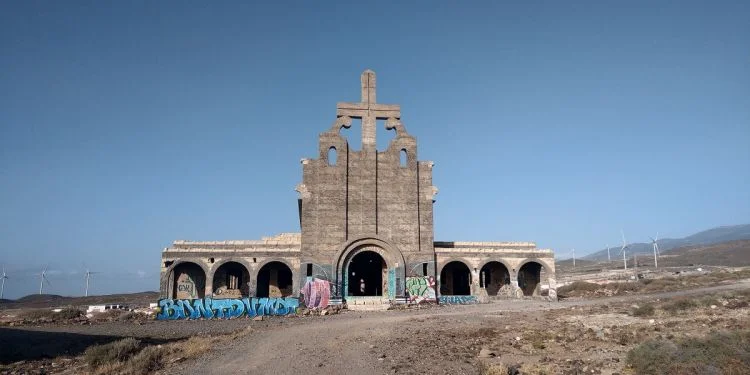
During the Spanish Civil War, which occurred just before the Second World War an outbreak of leprosy on the island of Tenerife raised alarm and by 1940, a total of 197 cases had been reported. The early medicine lacked familiarity with the infectious disease, and thus, crude methods of therapy and treatment were given to the afflicted.
The solution at that time was to isolate patients in quarantine in an arid, temperate climate, and Tenerife’s first leprosy station was established on the north side of the island. Later, a southern leper colony project was given the green light by the Spanish ruler Francisco Franco’s Falange military in 1942.
The "Sanatorio de Abona" was designed by Spanish architect Jose Enrique Marrero Regalado, who was well-versed in neo-canario monumental design. The sanatorium consisted of forty buildings, including a crematorium, dormitories, a hospital, and a church. The importance of the Catholic Church during Franco’s regime is observable via touches such as the enormous cross which overshadows the abandoned Tenerife sanatario. This display is a relic from Franco’s National Catholicism ideology. Patients were separated by gender and the sanatorium contained a dining hall, exam rooms, temporary residential quarters, and a recreation area.
However, a new drug Dapsone, an antibiotic which began to see use for treating leprosy in 1945, was more effective in fighting leprosy. Thus, the Sanatorio de Abona was already obsolete when it was constructed, and the project was canceled, leaving the half-built town dormant for two decades. In the 1960s, the military found a use for the former sanatorium as a training facility called the "Escuela de Magisterio," which was in service until 2002. Several items today remind of the former military use. Squadron graphics adorn walls and traces of used ordnance can be found when walking the grounds. Remains of once-organized wired fencing still linger. In 2002 the approximately 900,000 square meter hilltop property was to be sold to an Italian investment group for 17 million Euros. The new owner’s intentions were to build a seaside 3,000-bed resort featuring every amenity and two golf courses, for good measure. The town of Abades was enthusiastic about the deal; town authorities glowed in anticipation of the activity and revenue such a resort would bring the community. But a series of tourism control laws instituted by the government curbed any development. A 2001 moratorium on expansion and the construction of new resorts was the first major blow to development hopes for the former Sanatorio de Abona. Known as “La Ley de Moratoria Turística” or "The tourism moratorium law", it was intended to preserve the island’s culture by restricting over-development. Thus the deal fell through and the hilltop next to Abades would not be developed. Once again, the former sanatario was in limbo.
Over the years the buildings of the Sanatorio de Abona have seen limited use – both authorized and unauthorized – while they have slowly decomposed. Paintballers and ravers have taken the liberty of using the grounds on occasion. Graffiti artists have had more than a decade to add their contributions. In 2008 the property was used as a filming location for several scenes of the “Plan América” Spanish series by Televisión Española.
28.14575, -16.43917